25 Vintage Police Record Photographs «TwistedSifter

So today I came across the website Twisted Sifter, an Australian image blog that has some great finds. This is one of them – police photos from the 20′s, 30′s and 40′s around Sydney and New South Wales.

Warning – graphic images.

25 Vintage Police Record Photographs «TwistedSifter.

Construction of the Golden Gate Bridge

Construction of the Golden Gate BridgeThe always outstanding Retronaut.co has some fantastic images that were taken during the construction of the Golden Gate Bridge, in the years leading up to 1937. The bridge got it’s name from the Golden Gate  - the body of water that connects the San Francisco Bay to the Pacific Ocean –  and is one of the worlds most photographed bridges. See here some of the very first of those photographs.


Retronaut.co – Golden Gate Bridge

Woolworths in NYC ca 1913

I just came across an amazing photo of a scene in New York City of the Woolworths building in 1913. It’s a nice large image, so you can get in there and see some detail. It’s interesting to see the line of traffic on the street to the right side of the photo.

Night Light 1913 via Shorpy.com

Itinerant Photography

Itinerant Photography

An interesting phenomenon that I’d never heard of before. Back in the 30′s, itinerant photographers would photograph many aspects of a town and it’s residents, then try to sell prints to said residents.

Here is a fairly large gallery of photo’s from this time period, hosted by the University of Texas’ Harry Ransom Center. It’s a fantastic look at how life was in the early part of the 1900′s. These photo’s are from the Corpus Christi area circa 1930-1940.

Itinerant Photography

Junkstock – Clifton Paint 31


The word for the day is simplicity. And Junkstock captures the idea behind that word extremely well with this photo. This image, while containing almost nothing – a few flakes of paint peeling from a worn wall – manages to still present us with age, time, history, a feeling of ancientness. The simple and sparse colors and tones, as well as the gloomy, almost despondent, lighting help to back up the effect.

But there is detail here as well. Each crack represents a ray of fading sunlight, a gust of wind, an element of decay. And it is the process of decay that tells the story. It is the crumbling disrepair that is the story itself. What we see here is a life that was once happy and vibrant, now withered and disappeared. What we see here is a person, maybe a family, someone who cared about this structure enough to cover it with a color that suited their mood. And we see how time marched on and caused the decline of whatever situation caused that person or family to care about this place. And it brings the realization that we all will have to abandon our current little corner of the universe one day, and that perhaps in the future someone will come along with a camera to snap a picture of what we’ve left behind, and share our story with the world.

Flicker of the day: SX-70 Time Zero photo manipulation

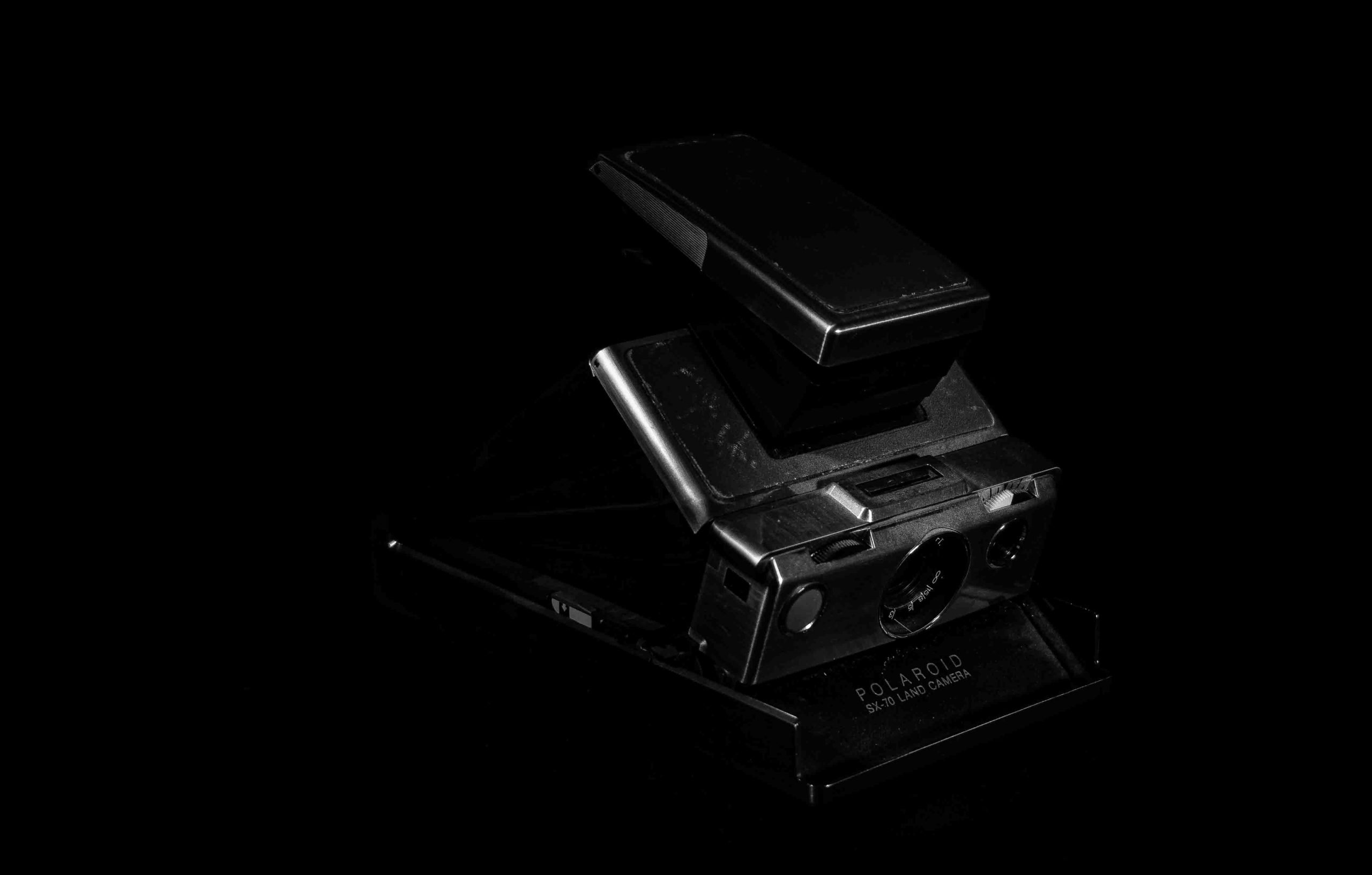
The SX-70 is a fascinating little camera made by Polaroid back in the early 70′s. One of the things that makes this camera interesting is that the film it uses, Time-Zero, can be manipulated after the picture is taken using your fingers or other things like pencils or toothbrushes. Even without the manipulation, the film has a unique look to it – strangely tinted skies and color-cast subjects, with a hazy, unfocused look combine for an overall effect – dark, ethereal and morose, almost archaic. Today, there are still people using the SX-70 to create these heavily artistic images that take you back to a time when the world was a little more innocent, yet much much stranger and exotic, with shadowed mysteries around every corner and things you wonder about all around.

Here is a shot by tobysx70 on flickr that demonstrates the photo manipulation technique.

Here’s a nice shot of London done with Time Zero film.

It really is amazing to me how creative you can get when the technology in your hands is limited; would I get a shot that conveys as much emotion and feeling as the above if I was using my crystal clear Canon EOS? I wonder what would happen if I took the shot with an SX-70, with its dirty rollers and its inclination to distort and discolor the image as it develops. I have an SX-70 with one pack of Time-Zero film. That’s ten exposures. I wonder what I should shoot with them.

See the Time Zero Collective group on flickr.com for more.

http://www.flickr.com/photos/8426916@N04/5016660084/in/pool-timezero#/photos/8426916@N04/5016660084/in/pool-58144320@N00/

Hugh Morton

Downtown Wilmington, NC at night in the late 1940'sHugh Morton was the grandson of Hugh Macrae. If you grew up, or lived for just a little while, in Wilmington, NC, then you’ve probably heard the name Hugh Macrae – at the very least you’ve been by Hugh Macrae Park for a stroll around the pond once or twice. Hugh Morton, among other things, was an avid photographer. The fine folks at the University of North Carolina’s library have put together a collection of Mr. Morton’s photos that you can browse. I had hours of fun looking through the Wilmington photos and trying to locate the same spots on google street view. It is interesting to see how places you’re so familiar with have changed over the decades. For instance, I have seen a spot on the sidewalk on Front St. that has tile in a pattern that says ‘Bijou’, but there is no building there. If you search through the images presented here, you’ll indeed find the old Bijou building, and many more that don’t exist anymore. From a historical standpoint, this collection is a goldmine.

For the main collection, click here. For a subset of photos based on the search term Wilmington, NC, click here.

Russian color photography ca. 1910

Now here is something truly amazing. The Boston Globe reports on a set of color photos of the Russian empire from around 1910. How did this happen, you ask? Well…

Back in the early 20th century, between 1905 and 1910, Sergei Mikhailovich Prokudin-Gorskii, a scientist and a photographer, had the idea of educating school children about the current state of Russia – it’s cultural diversity and progression into modern times – using photographs. His technique was interesting; he would take three black and white shots, one with a red filter, one with a blue and one with a green. He would then use a projector with the appropriate filters to project each image, perfectly aligned, to composite back into a color image.

Leo Tolstoy, 1908

Sergei had the support of Tsar Nicholas II as well. The Tsar provided him with a mobile darkroom on a railroad car. This allowed him to cover a vast area in his project, capturing a snapshot of the Russian Empire as it existed at the time.

The complete Sergei Mikhailovich Prokudin-Gorskii Collection is also available at the Library of Congress’ website, and you can read more about Sergei Mikhailovich Prokudin-Gorskii on wikipedia.

Russia in color, a century ago (Boston Globe)

Captured: America in Color from 1939-1943 – Plog Photo Blog

Thanks to my friend Paul, I came across this set of photographs from the early 40′s. They’re in color! These images show us a time when there was no internet, no television, no X-box or Wii, and definitely no cell phones. And yet, these people manage to get along just fine.

You can see a completely different country in these photos. It is interesting to me to realize that there are people alive today that remember these times the same way I remember the 70′s and 80′s. Memories of the church picnic, when Mrs. Smith wore that crazy hat; that one Christmas when Johnny got the erector set; the one time we all had to get up on stage at school and sing those songs in front of our parents and everybody; that day dad drove us all into town and took us to the drug store to get an orange soda for each of us, these are the types of memories that America just does not produce in the minds of it’s citizens anymore.

Look at the photos here but do more than look. Try to realize that what you’re seeing is a window into the past, a visual time capsule, a quantum device capable of time travel. Look at these and know that you’re seeing something that is lost forever.

Captured: America in Color from 1939-1943 – Plog Photo Blog.